Join to access to all OVN content. Join for Free
“Oncometabolism: The switchboard of cancer: An editorial”
Otto Warburg biochemist FDA FDG-PET MRS Oncometabolism

“Oncometabolism: The switchboard of cancer: An editorial”


Share This Article


Summary

  • Otto Warburg's discovery in the 1920s highlighted a unique bioenergetic phenotype in tumor cells, emphasizing their reliance on lactic acid fermentation, which spurred the field of oncometabolism.
  • Oncometabolism has led to advancements like FDG-PET imaging for cancer diagnosis and staging, although targeted metabolic treatments have shown limited success.
  • Research in oncometabolism was initially disregarded, but recent discoveries have linked energy metabolism to cellular processes, cementing its role in cancer research.
  • Advancements in metabolomics and proteomics, such as MRS and MS, have enhanced the understanding of tumor cell metabolism, leading to potential clinical applications.
  • Novel radiopharmaceuticals for PET imaging are under development, potentially improving cancer staging and treatment assessment.
  • Research is exploring the connections between intermediary metabolism and cell proliferation, targeting enzymes like DHODH and cell cycle regulators for therapy.
  • Mitochondria play a crucial role in carcinogenesis, with studies focusing on mitochondrial adaptations and functions in cancer.
  • Warburg's theory proposed a link between tumor cells and a subpopulation of cells in healthy tissues, analogous to stem cells.
  • Emerging research investigates the interaction between intermediary metabolism, epigenetics, and cellular phenotype.
  • Studies are examining the impact of lactate production on cancer cell survival and the influence of 3D tumor architecture on metabolism and signaling.
  • This special issue serves as a comprehensive reference for current and future oncometabolism research.

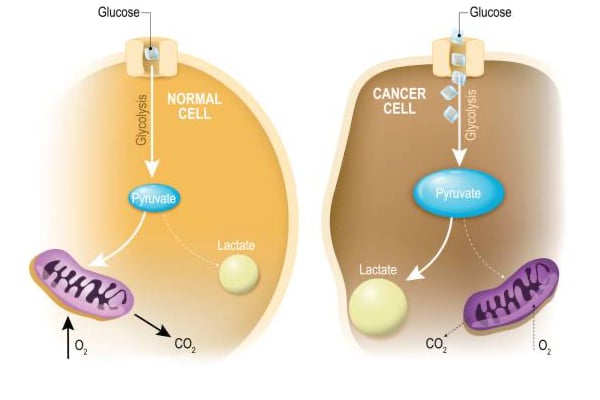
In the 1920’s, Otto Warburg, one of the greatest biochemists of all time, uncovered an intriguing bioenergetic phenotype shared by most tumor cells: a higher than normal reliance on lactic acid fermentation for energy generation. Warburg’s seminal finding gave rise to a new field of cancer research that came to be known as oncometabolism. Research in this fascinating field, which has since expanded its scope well beyond the metabolic processes of energy generation, has already translated into one of the most successful imaging techniques for the diagnosis and staging of tumors, 18F-deoxyglucose positron emission tomography (FDG-PET). Targeting the metabolic peculiarities of tumor cells for cancer treatment, on the other hand, has only yielded modest results. Recently, the Food and Drug Administration (FDA) granted approval to two inhibitors of mutated forms of isocitrate dehydrogenase (IDH)—IDHIFA® (enasidenib) and Tibsovo® (ivosidenib)—but only for certain forms of acute myeloid leukemia (AML). In this context, it must be stressed that drugs targeting nucleotide metabolism, which have been in the clinic for many decades, target proliferating cells in general, not tumor cells specifically. Nonetheless, it is still believed that a more detailed and comprehensive understanding of the metabolic rewiring that accompanies neoplastic transformation will ultimately translate into highly effective metabolic anticancer agents.

Click for Source Download PDF version
Otto Warburg, biochemist, FDA, FDG-PET, MRS, Oncometabolism

Related Topics

Meet Our Innovation Partners

Loading partners...

You May Also Like

Podcast
Oncology Pharmacology 2023: Today’s Treatments and Tomorrow’s Breakthroughs
OVN Avatar The Oncology Nursing Podcast

Oncology Pharmacology 2023: Today’s Treatments and Tomorrow’s Breakthroughs

Podcast
The Role of MSLs in Achieving Health Equity
Partner Avatar MSL Talk: Tom Caravela, Ariel Katz

The Role of MSLs in Achieving Health Equity

Podcast
How and Why Medical Affairs Can Support Diversity in Clinical Trials
Partner Avatar MSL Talk: Tom Caravela, Brad Atkinson, Brian Wilson, Christina Wright
How and Why Medical Affairs Can Support Diversity in Clinical Trials

Podcast
Compliance 101-Most common issues and MSL-related gray areas
Partner Avatar MSL Talk: Tom Caravela, Jessica McLin, Melody Davis
Compliance 101-Most common issues and MSL-related gray areas

Article
Evaluating External Validity of Oncology Biosimilar Safety Studies
OVN Avatar Gregory S. Calip, PharmD, MPH, PhD, Ivy P. Altomare, MD, Jenny S. Guadamuz, MSPH, PhD

Evaluating External Validity of Oncology Biosimilar Safety Studies

Article
Early phase clinical trial played a critical role in the Food and Drug Administration-approved indications for targeted anticancer drugs: a cross-sectional study from 2012 to 2021
OVN Avatar Yafang Huanga, Weiyi Xiongb, Jingwei Zhaoa, Wentao Lia, Li Mac, Hao Wua

Early phase clinical trial played a critical role in the Food and Drug Administration-approved indications for targeted anticancer drugs: a cross-sectional study from 2012 to 2021

Explore OVN