Podcast
 Rebecca Previs


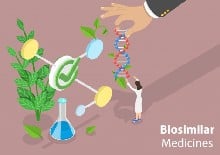
Biologics are an increasingly central element of the cancer treatment armamentarium. Unlike traditional pharmaceuticals, which are usually small molecules, biologics are large compounds derived from living organisms, or recombinant proteins produced by cells transformed with the genetic information encoding the corresponding protein. Typically, they are protein based, with inherently complex sequences and 3D structures. Unlike small-molecule drugs, they cannot be manufactured chemically. Instead, living host systems are required, which are typically human or animal cells; the process is inevitably harder to control than the process of chemical synthesis.
The importance of biologics in oncology is exemplified by the fact that the three biggest selling cancer drugs of 2015 were all monoclonal antibody-based biologics: rituximab, bevacizumab and trastuzumab. At that time, all three remained under patent protection. However, since then, the patent protection for these biologic agents has expired and biosimilar forms of each drug are now available. This represents the beginning of a new era in oncology.
Rebecca Previs
 Rebecca Previs
 Rebecca Previs
 Gregory S. Calip, PharmD, MPH, PhD, Ivy P. Altomare, MD, Jenny S. Guadamuz, MSPH, PhD
 Qiyou Wu, Zhiwei Lian, Xin Wang, Hanchao Cheng, Jing Sun, Hui Yu, Gong Zhang, Fan Wu, Jian Liu and Chuanben Chen
 John Devin Peipert, PhD, Karen Kaiser, PhD, Sheetal Kircher, MD, George J. Greene, PhD, Sara Shaunfield, PhD, Katherina Hauner, PhD, David Cella, PhD, and Daniel K. Mroczek, PhD