Podcast
 MSL Talk: Tom Caravela, Mitchell D’Rozario

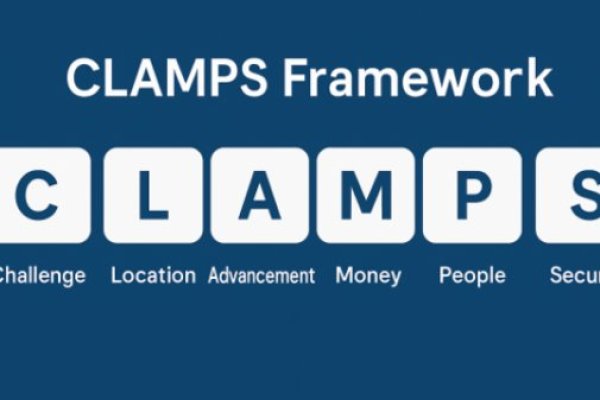
In career conversations, one of the most common questions I hear is: “How do I know if it’s time to move on from my company?” The real decision often comes down to a mix of factors that influence job satisfaction and long-term career growth. That’s why I use the CLAMPS framework.
CLAMPS is simple acronym that highlights six common pain points that lead to job changes. If you can identify at least two of these in your current role, it may be time to consider a change.
Enjoy a short video that outlines the CLAMPS framework.
C – Challenge Are you under-challenged or over-challenged?
Under-challenged: The work feels repetitive, easy, and uninspiring. You crave growth, but the role no longer stretches you.
Over-challenged: The workload is overwhelming, expectations are unreasonable, and the effort isn’t matched by compensation.
Both extremes can drive restlessness. The key is to find that balance where you’re stretched, but not stretched thin.
L – Location Sometimes it’s not the job, it’s the geography.
Location is often overlooked until it starts impacting health, family, or performance.
A – Advancement When there’s no clear path forward, employees naturally start looking elsewhere.
But remember: lack of advancement often pairs with other CLAMPS issues (challenge, people, or security).
M – Money Compensation matters, but it’s rarely the only reason people move on. Still, when pay isn’t aligned with market value or the scope of responsibility, it becomes a major motivator.
I see this most often with employees who broke into industry with their current company. Often their employer cannot give them raises that keep pace with market value. After a few years, the person is grossly underpaid, and that typically spurs a job change.Similarly, when someone is promoted from within, they don't tend to get the full market-value salary. After gaining a couple years of experience, they seek to be a free agent to get their salary right-sized.
P – People One of the biggest reasons people leave is not the work itself, but who they’re working with.
When relationships sour, no amount of salary or perks can fix the situation.
S – Security The final, and often most powerful, factor is security. If the company’s stability is in question, or if layoffs loom, people instinctively protect their livelihood. Job security often outweighs every other factor in CLAMPS.
Why CLAMPS Matters The CLAMPS framework reminds us that career moves are rarely about a single frustration. They’re usually about a combination of pain points. When at least two areas of CLAMPS are consistently out of alignment, most professionals start to look for greener pastures.
For leaders, understanding CLAMPS helps us:
The CLAMPS model is a mirror. It gives you a structured way to evaluate whether the frustrations you’re feeling are temporary, or a sign it’s time for your next move. Was this helpful? Information like this can be routinely found on my podcast: The Pharmaverse Podcast.
About the Author: Michael Pietrack leads the power-packed Life Sciences Recruiting team at Kaye/Bassman International (www.KBICLifeSciences.com). With nearly 20 years of high performance, Pietrack is the go-to recruiter in Medical Affairs. Additionally, he is a trusted voice on leadership. He hosts a leadership podcast called The Pharmaverse and writes a column for BioSpace called Leadership Lab.
MSL Talk: Tom Caravela, Mitchell D’Rozario

 Michael Pietrack
 Michael Pietrack

 Avi Cherla, MSc; Huseyin Naci, MHS, PhD; Aaron S. Kesselheim, MD, JD, MPH; Bishal Gyawali, MD, PhD; Elias Mossialos, MD, PhD
Michael Pietrack
Jamie Riley
Avi Cherla, MSc; Huseyin Naci, MHS, PhD; Aaron S. Kesselheim, MD, JD, MPH; Bishal Gyawali, MD, PhD; Elias Mossialos, MD, PhD
Michael Pietrack
Jamie Riley